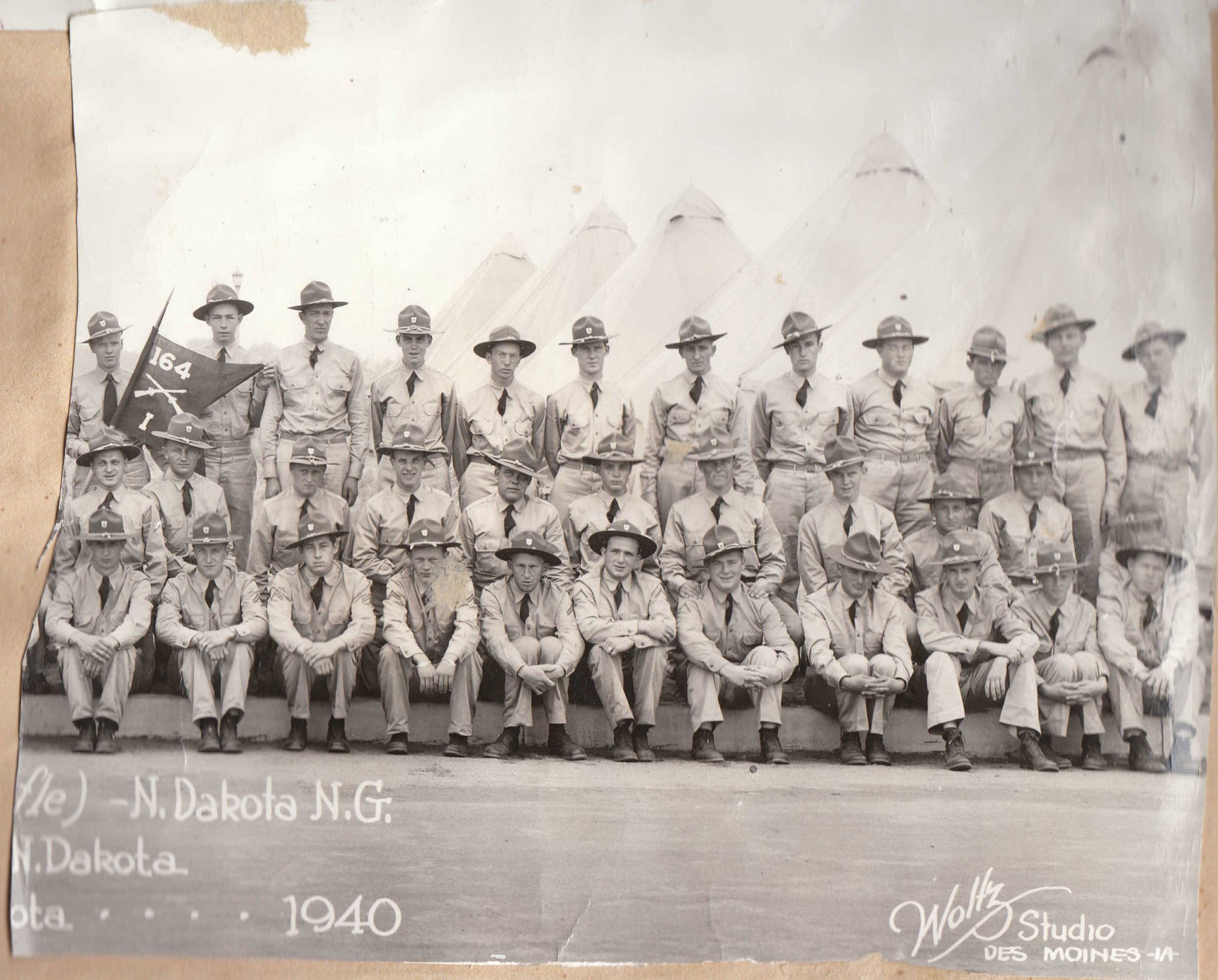
The Story of the 164th Infantry
The 164th Infantry Regiment of the North Dakota National Guard entered World War II as a traditional citizen-soldier unit—men drawn largely from rural towns and communities across North Dakota. Federalized in February 1941, the regiment spent months training in the United States before the attack on Pearl Harbor transformed preparation into urgency. By 1942, the 164th was bound for the Pacific, where it would become one of the most historically significant National Guard regiments of the war.
Camp Claiborne and the Louisiana Maneuvers
Before the 164th Infantry Regiment ever faced combat in the Pacific, it was forged into a wartime unit at Camp Claiborne, one of the U.S. Army’s largest and most demanding training centers during World War II. Located in central Louisiana, Camp Claiborne became the regiment’s primary training ground after federalization in 1941 and played a decisive role in preparing the North Dakota National Guardsmen for modern warfare.
At Camp Claiborne, the 164th Infantry underwent intense field training focused on small-unit tactics, weapons proficiency, jungle movement, and extended operations under austere conditions. Soldiers trained in heat, humidity, and rough terrain far removed from the climate and landscapes of the northern Great Plains. This environment tested physical endurance, discipline, and cohesion—qualities that would later prove essential in the Pacific.
The regiment also participated in the Louisiana Maneuvers of 1941, the largest military training exercises in U.S. history up to that time. These massive war games involved hundreds of thousands of troops and were designed to test new doctrines of mobility, command, logistics, and combined arms operations. For the 164th Infantry, the maneuvers provided invaluable experience operating as part of a larger field army, responding to rapidly changing battlefield conditions, and functioning under realistic combat stress.
At Camp Claiborne, the citizen-soldiers of North Dakota transitioned from peacetime Guardsmen into a disciplined, combat-ready regiment. The long marches, live-fire exercises, night operations, and large-scale maneuvers forged leadership at every level—from officers to noncommissioned officers to enlisted men. The professionalism developed there directly contributed to the regiment’s ability to integrate seamlessly with U.S. Marine forces on Guadalcanal and to endure prolonged jungle combat on Bougainville and in the Philippines.
In many ways, Camp Claiborne was where the 164th Infantry truly became a wartime unit. Long before their first shots were fired in anger, the regiment proved itself ready—Je Suis Prêt—on the training grounds of Louisiana, setting the foundation for its historic service overseas.
New Caledonia and the Birth of the Americal Division
Before entering combat on Guadalcanal, the 164th Infantry Regiment spent a critical period of preparation in New Caledonia, a strategically vital Allied base in the South Pacific. Arriving in mid-1942, the regiment joined other Army units assigned to defend the island and prepare for future offensive operations against Japanese forces advancing through the Solomon Islands.
New Caledonia served as a proving ground where the 164th Infantry transitioned from stateside training to overseas service. Soldiers adapted to tropical conditions, conducted jungle training, improved weapons proficiency, and rehearsed amphibious and defensive operations. The environment—marked by heat, rugged terrain, and isolation—mirrored many of the challenges they would soon face in combat and helped harden the regiment physically and mentally.
It was on New Caledonia that the 164th Infantry became part of a new and uniquely organized formation: the Americal Division. The division’s name was derived from “AMERican, New CALedonia,” reflecting its unconventional origin. Unlike traditional divisions formed and trained together in the United States, the Americal Division was assembled overseas from separate National Guard and Regular Army units already deployed in the Pacific. The 164th Infantry, along with the 132nd and 182nd Infantry Regiments, formed the core of this new division.
The formation of the Americal Division represented a significant adaptation by the U.S. Army to the demands of the Pacific War. On New Caledonia, the 164th Infantry trained alongside its future sister regiments, establishing unit cohesion, command relationships, and operational standards under combat-realistic conditions. This preparation proved invaluable when elements of the division—beginning with the 164th Infantry—were called upon to reinforce U.S. Marine forces on Guadalcanal.
By the time the regiment departed New Caledonia for combat, the citizen-soldiers of North Dakota were no longer simply a National Guard regiment overseas. They were part of a newly formed combat division, trained, organized, and ready for immediate action. The experience in New Caledonia and the creation of the Americal Division laid the foundation for the 164th Infantry’s historic role as the first U.S. Army unit to enter ground combat in World War II and for its continued service across the Pacific.
Guadalcanal: First Army Ground Combat of WWII
In October 1942, the 164th Infantry landed on Guadalcanal, becoming the first U.S. Army unit to engage in ground combat during World War II. The Marines had been holding the island under extreme pressure—short on supplies, exhausted, and facing relentless Japanese attacks. The arrival of the North Dakotans provided not only manpower but renewed stability to the defensive perimeter around Henderson Field. It was here that the 164th Infantry became the first U.S. Army unit to take offensive action against the Axis powers in WWII.
The regiment was immediately thrown into front-line combat, fighting in dense jungle terrain under constant threat of night attacks, artillery, disease, and exhaustion. Soldiers of the 164th helped repel major Japanese assaults during critical phases of the campaign, operating seamlessly alongside Marine units in what became an early and successful example of joint Army–Marine operations. Their discipline and effectiveness earned the admiration of Marine commanders, and the regiment was later awarded the Presidential Unit Citation for its extraordinary heroism and performance on Guadalcanal.
Bougainville: Sustained Jungle Warfare
After Guadalcanal, the 164th Infantry continued its Pacific service during the Bougainville Campaign in late 1943 and 1944. There, the regiment faced a different but equally demanding form of combat—long-term jungle operations against entrenched Japanese forces in difficult terrain marked by swamps, mountains, and torrential rain.
On Bougainville, the 164th conducted perimeter defense, patrols, and offensive actions designed to contain and neutralize enemy forces while Allied strategy shifted toward bypassing heavily defended islands. Combat was often close-quarters and relentless, testing endurance as much as marksmanship. Disease, fatigue, and supply challenges were constant companions. The regiment’s ability to operate effectively under these conditions reflected its growing professionalism and battle-hardened experience.
The Philippines: Liberation and Final Campaigns
In 1944–1945, the 164th Infantry took part in operations in the Philippines, contributing to the liberation of territory that had been under Japanese occupation since 1942. Fighting there combined jungle warfare with rugged terrain and increasingly desperate enemy resistance. The regiment participated in clearing operations, defensive actions, and patrols that helped secure key areas as Allied forces pushed toward final victory in the Pacific.
By the time the Philippines campaign concluded, the 164th Infantry Regiment had evolved from a peacetime National Guard unit into a seasoned combat formation. Its soldiers had endured some of the harshest conditions of the war—combat, climate, and disease—while maintaining cohesion and discipline across multiple campaigns.
Legacy
The wartime service of the 164th Infantry Regiment stands as one of North Dakota’s most significant contributions to World War II. From Guadalcanal to Bougainville and the Philippines, the regiment exemplified the National Guard tradition: ordinary citizens called to extraordinary service. Their motto—Je Suis Prêt (“I Am Ready”)—proved not just aspirational, but prophetic.
Works Cited (MLA)
Anderson, Charles R. Guadalcanal: 7 August 1942–21 February 1943. Center of Military History, United States Army, 1993, https://history.army.mil/Portals/143/Images/Publications/Publication%20By%20Title%20Images/C%20Img/campaigns-wwii/pdf/18.pdf. Accessed 12 Feb. 2026.
Lofgren, Stephen J. Northern Solomons: 22 February 1943–21 November 1944. Center of Military History, United States Army, 1993, https://www.officialmilitaryribbons.com/pdf/publications/northern_solomons_CMH_Pub_72-10.pdf. Accessed 12 Feb. 2026.
Southern Philippines: 27 February–4 July 1945. Center of Military History, United States Army, https://history.army.mil/portals/143/Images/Publications/catalog/72-40.pdf. Accessed 12 Feb. 2026.
“Louisiana Spotlight: Camp Claiborne.” The National WWII Museum, 9 June 2020, https://www.nationalww2museum.org/war/articles/louisiana-camp-claiborne. Accessed 12 Feb. 2026.
“The Louisiana Maneuvers.” The National WWII Museum, 11 July 2017, https://www.nationalww2museum.org/war/articles/louisiana-maneuvers. Accessed 12 Feb. 2026.
“Training for WWII.” Dickinson Public Library (City of Dickinson, ND), https://www.dickinsongov.com/library/page/training-wwii. Accessed 12 Feb. 2026.
“Guadalcanal Campaign.” Dickinson Public Library (City of Dickinson, ND), https://www.dickinsongov.com/library/page/guadalcanal-campaign. Accessed 12 Feb. 2026.
“Bougainville Campaign.” Dickinson Public Library (City of Dickinson, ND), https://www.dickinsongov.com/library/page/bougainville-campaign. Accessed 12 Feb. 2026.
“Note on Navy Presidential Unit Citation.” Elwyn B. Robinson Department of Special Collections, University of North Dakota, 164th Infantry Association Records (OGLMC-1278-164), https://archives.und.edu/repositories/2/archival_objects/55959. Accessed 12 Feb. 2026.
Shoptaugh, Terry. They Were Ready: The 164th Infantry in the Pacific War, 1942–1945. 164th Infantry Association, 2010.
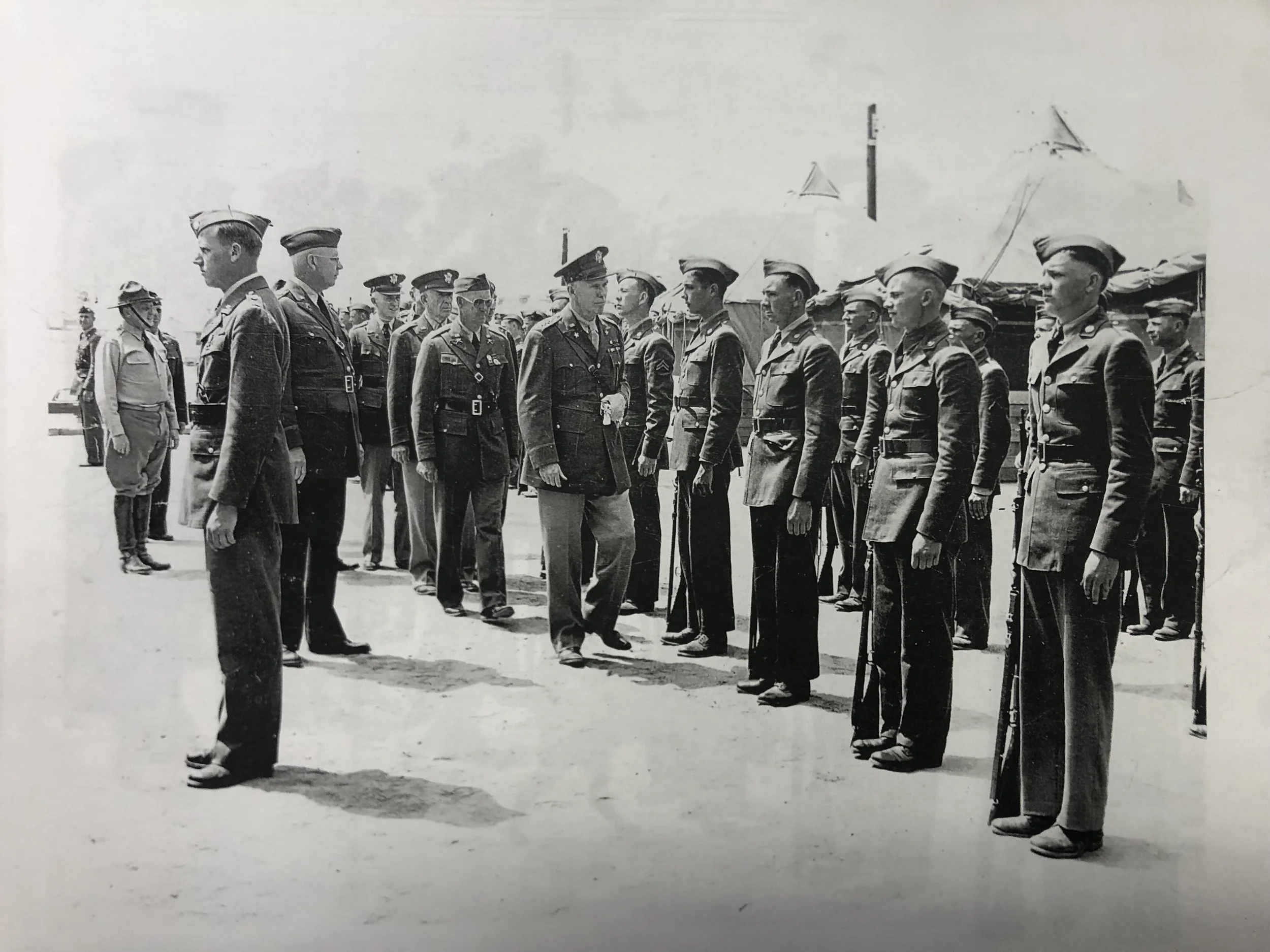
Army Chief of Staff General George C. Marshall inspects soldiers of Co. E (Williston) of the 164th Infantry Regiment at Camp Claiborne, Louisiana, just after the Louisiana Maneuvers in September 1941. Behind Marshall is Captain C.O. Harding, Commander of Co. E, behind him is Lieutenant General Walter Krueger, Commander of Third Army and who was in charge of the “Blue Force” during the Louisiana Maneuvers. Behind Krueger is Lt. Col W.W. Jeffrey, former Co. E commander, and whose son, Jeffrey, was currently a lieutenant. To the left of Jeffrey is Colonel Earle Sarles, Regimental Commander 164th Infantry Regiment.
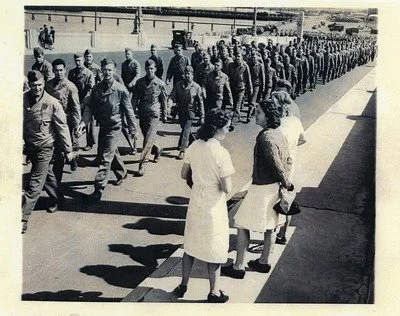
164th Infantry off loading from ships in Australia prior to their being sent to Guadalcanal. Picture in Life magazine, June 1942. Picture submitted by Blake Kerbaugh."
Courtesy of Elwyn B. Robinson Department of Special Collections, Chester Fritz Library, University of North Dakota
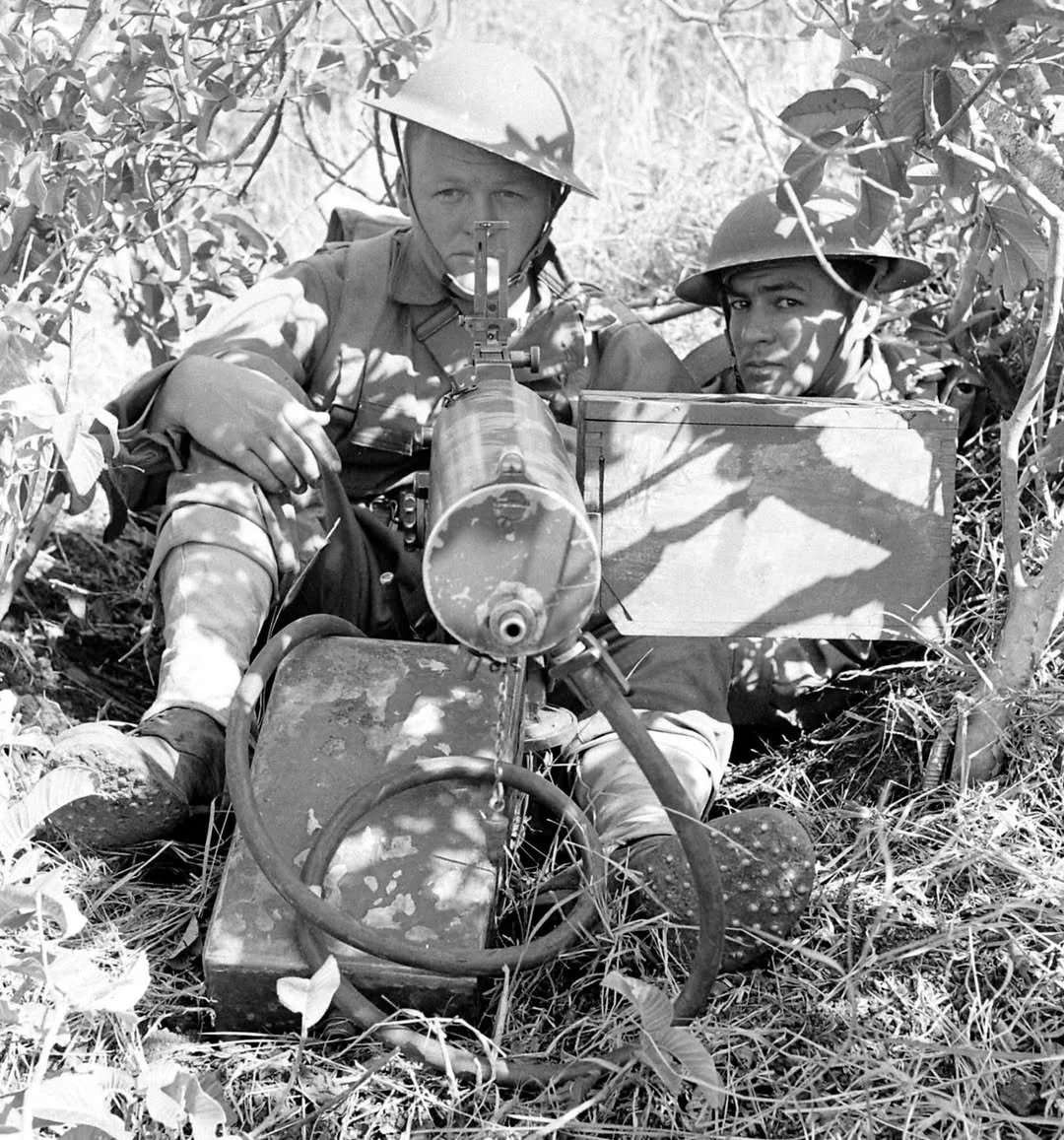
US Soldiers with the 164th Infantry Regiment with a Browning water-cooled M1917A1 .30 cal MG on New Caledonia - 1942
LIFE Magazine Archives - Wallace Kirkland Photographer WWP-PD

Mortar crew of 164th Infantry Regiment on Bougainville Island, 22 March 1944.
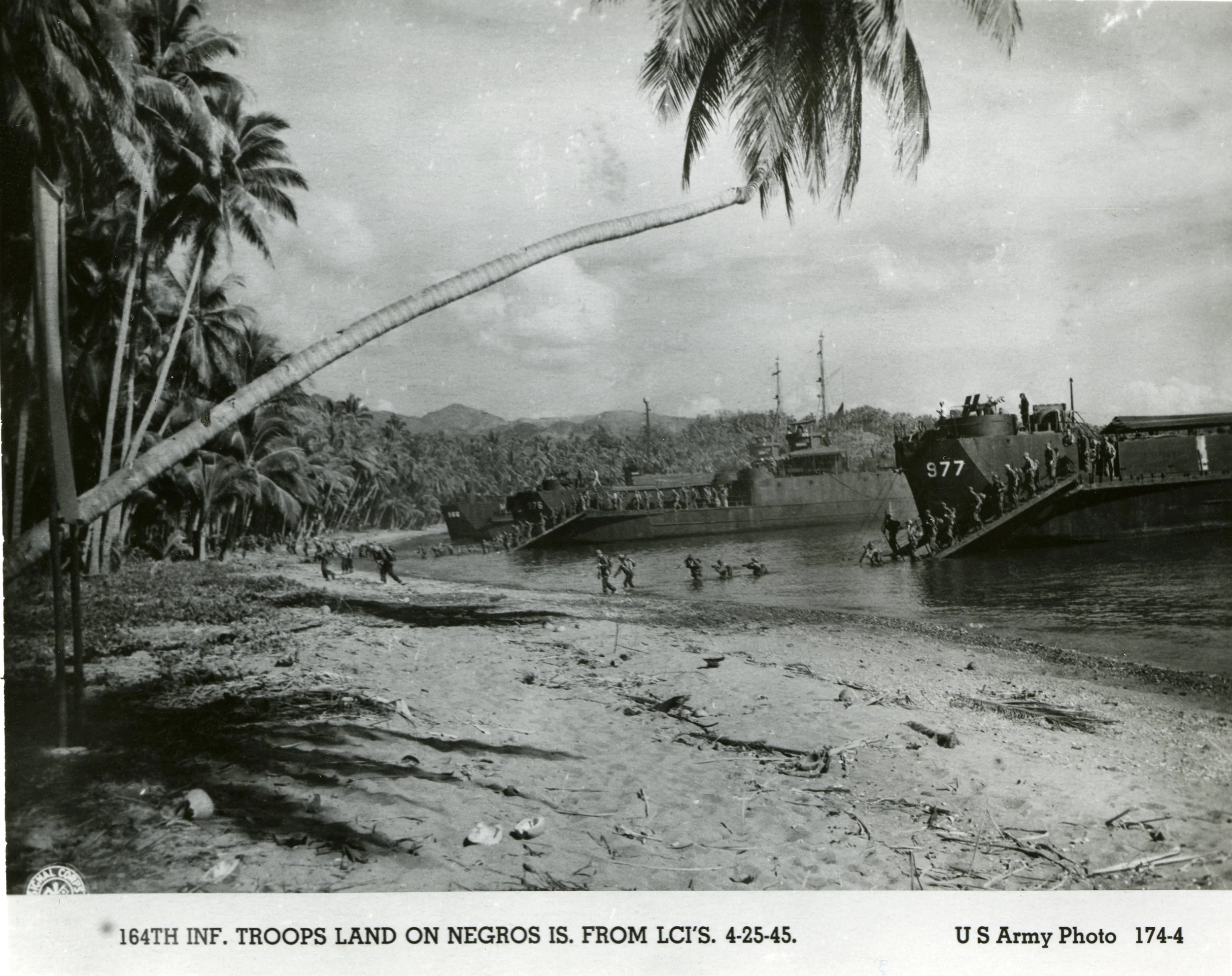
The 164th Infantry Regiment, Americal Division, disembark from LCI’s at Negros Island, P.I. 4/25/45.
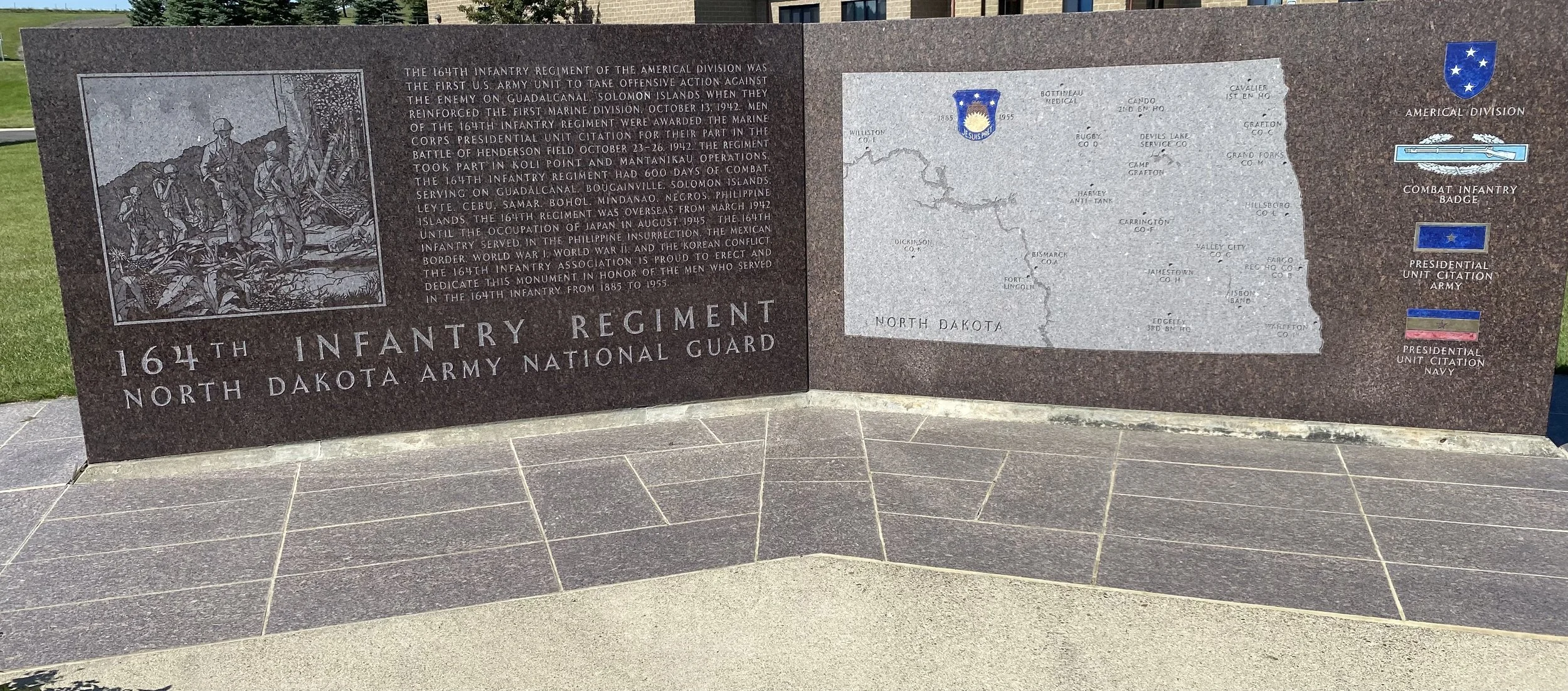
The 164th Infantry Regiment Memorial, located at the North Dakota Veterans Cemetery, Mandan, North Dakota.